Inside the controlled test.
The monitoring engine was tested on a local WordPress installation with Contact Form 7. We created 19 scenarios and repeated each three times: 57 checks in total. These are authored test cases, not 57 independent customer sites.
What happened
| Controlled situation | Observed result |
|---|---|
| Normal enquiry or a short delivery delay | Matched the test message in the simulated inbox. |
| Form said sent, but message was dropped or sent elsewhere | Reported unverified delivery instead of healthy. |
| Sending step explicitly failed | Reported a mail-transport failure. |
| CAPTCHA, an unknown required field, or multiple forms | Stopped before submission and reported unsupported setup. |
| A healthy message took five seconds to arrive | Warned under a 2.2-second deadline. A fresh check with a 6.5-second deadline verified arrival. |
All 57 checks matched the expected classifications. None of the 30 fault/rejection checks was labelled healthy. Three deliberately slow but healthy deliveries triggered warnings under the short deadline, so that deadline is unsuitable as an immediate outage rule.
One actual failure result
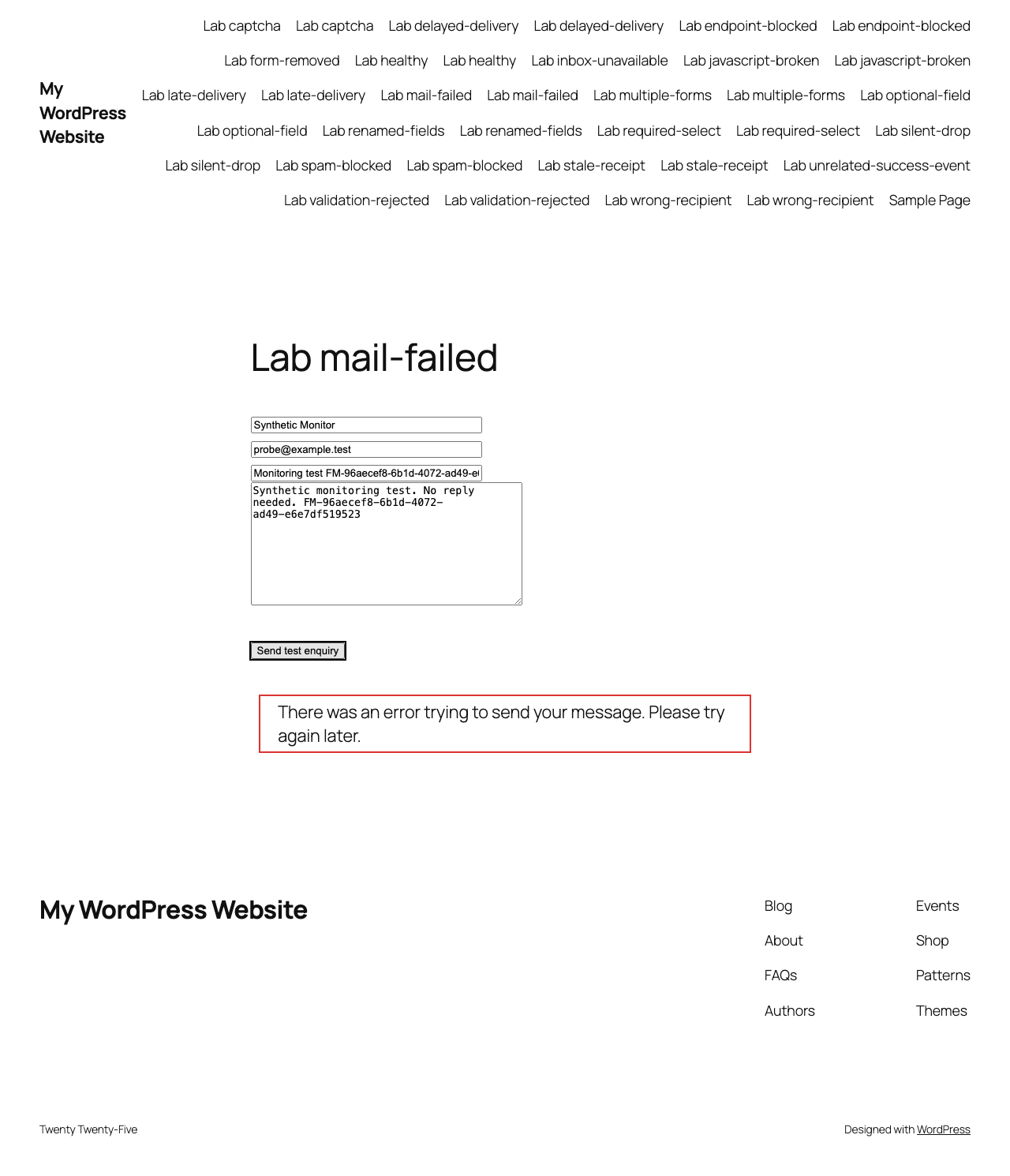
This is an excerpt from a real browser-driven run against our local test site. We deliberately made WordPress reject the sending step.
{
  "scenario": "mail-failed",
  "outcome": "failure",
  "reason": "mail_transport_rejected",
  "cf7_status": "mail_failed"
}
What this does not prove
- Email delivery used a separate local HTTP inbox. Real SMTP, spam folders, customer inboxes and CRM routing were not tested.
- Repeating our own scenarios does not establish real-world accuracy, broad compatibility, unattended reliability or customer demand.
- There is no installable plugin or live monitoring service available today.
The test supports a narrow next experiment: real email verification and repeatable setup. It is not an uptime guarantee or a production accuracy claim.
Back to the interest check